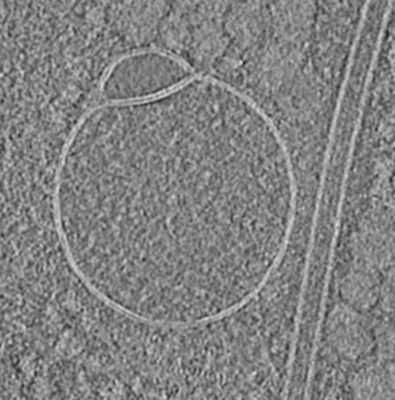
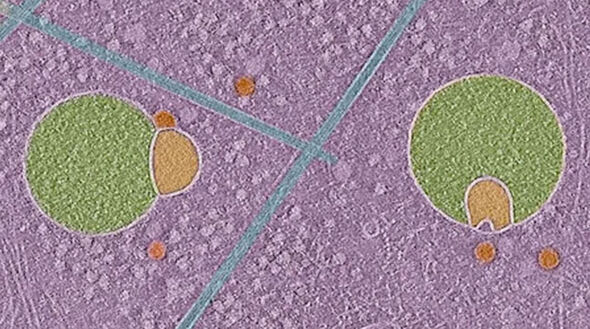
Scientists have discovered a never-before-seen part of a human cell that could help research on Alzheimer's disease. The new organelle, the experts are calling 'hemifusome', was uncovered by Seham Ebrahim, an assistant professor at the University of Virginia and her team, observing filaments that maintain the shape of cells.
What seemed like an artefact in the images turned out to be a new organelle. Similar to full-size organs in the human body, organelles within cells also have specialised structures that carry out specific roles. It is believed that the hemifusome may be involved in sorting, recycling, and discarding proteins within human cells.
The organelle is appoximately 100 nanometres in diameter, which is less than half the size of a small mitochondrion, often called the 'powerhouses of the cell', reports Live Science.
The scientists used a method called cryo-electron tomography (cryo-ET), which allowed them to observe the hemifusome. The technique involves quickly freezing cells from four lab-raised cell lines to preserve as much of their structure as possible and generate clear, 3D images.
Ebrahim said: "It's like a snapshot in time without any kind of chemical or any kind of stain."
The paper, published in the journal Nature Communications, states that harsh processing steps used by other imaging techniques likely prevent hemifusomes from being observed earlier. Additionally, the organelle was probably too small to be seen, appearing as a blur at most, Ebrahim added.
The cryo-ET method, however, allowed scientists to look inside cells in a "very native state".
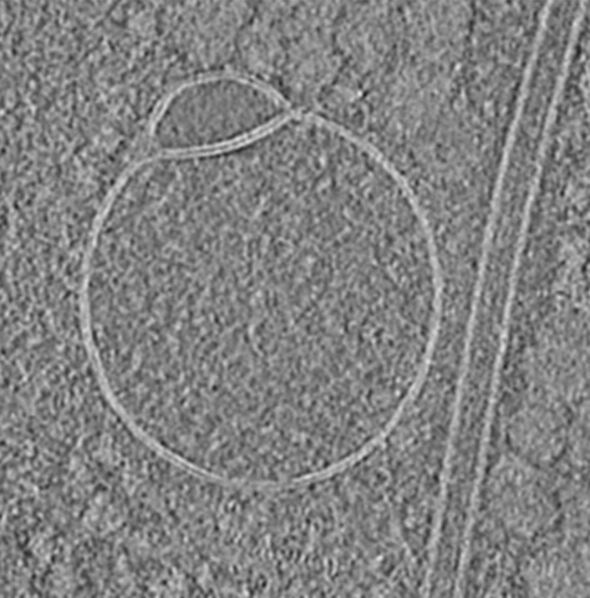
The team was examining a configuration of vesicles they had never observed before. Vesicles are balloon-like structures used to transport proteins and hormones within and between cells.
The study revealed two vesicles fused together with a two-layer barrier of fat between them, which Ebrahim described as a "breakthrough".
She added: "Because biophysically, people have always predicted, or theorized, that vesicles can exist in this hemifused state... but this was the first time that it has actually been seen in a living cell."
She argued that hemifisomes can be classified as organelles because they are self-contained functional units within a cell rather than "fleeting" structures that appear as membranes form and split. Ebrahim also wrote in the paper that the organelle was unlikely to be an artefact of cryo-ET.
Though researchers can confirm that the hemifusome exists, they have yet to determine the organelle's exact role, life cycle, or composition.
The study explains that understanding more about how hemifusomes work could offer new insight into how diseases such as Alzheimer's manifest. Alzheimer's disease is linked to the improper clearance of abnormal protein plaques in the brain, which leads to build up over time.
"Without cryo-electron tomography, we would have missed this discovery," Ebrahim said, adding that "there's probably a whole world out there that we still have to find."