Cloud Seeding: Cloud seeding is in the news these days. Recently, an attempt to induce artificial rain, i.e., cloud seeding, was unsuccessful in Delhi, the capital of the country suffering from severe air pollution. The reason for this failure is attributed to a lack of moisture in the clouds. Learn about cloud seeding technology and when it was first used...
Cloud Seeding: Cloud seeding is used to induce artificial rain in times of low rainfall or drought. It is a scientific technique for artificial rainmaking, in which conditions for rain are created by spraying certain chemicals into the air. Cloud seeding is used in many countries around the world to increase winter snowfall and mountain ice caps, ensuring a smooth natural water supply to surrounding communities.
Cloud Seeding is a Scientific Way to Induce Rain
Cloud seeding is a scientific process. In this process, chemicals are sprayed into clouds to accelerate the natural rainfall process. To do this, extremely fine particles of substances like silver iodide, potassium iodide, and salt are released into the atmosphere. This process is primarily completed in three steps:
Identification of Clouds: Scientists first identify suitable clouds with sufficient moisture. Not all clouds are suitable for artificial rain. Cloud seeding requires clouds with a temperature of around zero degrees Celsius.
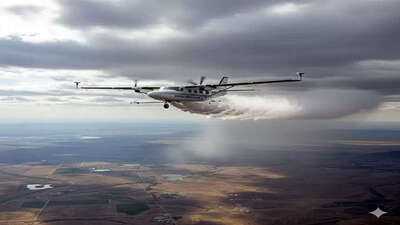
Chemical Spraying: The identified clouds are sprayed with specific chemicals using aircraft or drones. These substances are called "seeding agents." Silver iodide, sodium chloride, and dry ice are the main seeding agents. Silver iodide is the most common and effective agent. It creates ice crystal-like structures in clouds. Sodium chloride is often used in warm clouds. Dry ice is used in very cold clouds.
This is how artificial rain happens.
The third step is rain. When sprayed chemical particles reach clouds, they accelerate the process of condensation by gathering moisture (tiny water droplets or vapor) around them. Particles like silver iodide act as nuclei, around which water droplets rapidly gather. Gradually, these droplets become larger and heavier. When the weight of these droplets becomes so great that the clouds cannot support them, they begin to fall due to gravity, creating artificial rain. This technique is used in areas where rainfall is low, drought occurs, or to reduce air pollution by settling dust and pollutants to the ground through rain.
Discovery of the Principle of Cloud Seeding
American scientist Vincent J. Schaefer discovered the principle of cloud seeding in 1946 while working at the General Electric Company laboratory. Schaefer was researching the problem of ice formation on airplanes. In a deep-freeze unit, he accidentally mixed a piece of dry ice (solid carbon dioxide or dry ice) into an artificial cloud created by breathing, creating millions of ice crystals. Later, Schaefer's colleague, Bernard Vonnegut, discovered that silver iodide was even more effective at forming ice crystals, leading to the invention of modern cloud seeding techniques.
The Beginnings of Cloud Seeding in India
The Indian Institute of Tropical Meteorology (IITM) reports that this technique was first used in Delhi during the 1957 monsoon season. A second test was conducted in the winter of 1971-72 at the National Physical Laboratory campus, where silver iodide particles were released from ground-mounted generators. Cloud seeding has also been used in Indian states like Maharashtra, Karnataka, and Tamil Nadu to address drought and increase water supply.