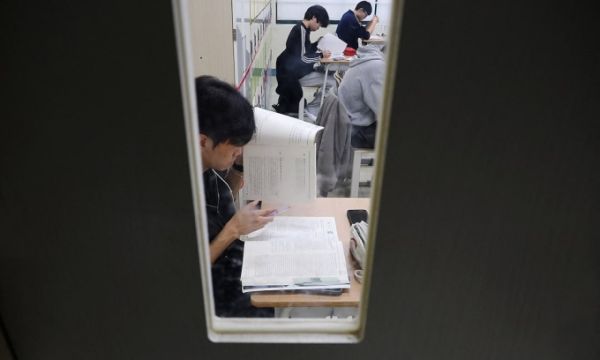
The 2025 College Scholastic Ability Test (CSAT), held on Nov. 13, sparked fierce debate the moment students walked out of testing centers. Many highly educated native English speakers who later tried the questions described parts of the exam as “crazy” after seeing the dense passages and tricky multiple-choice items that teenagers were expected to decode.
“In general, I find the difficulty level of the questions ridiculous, I’d wager that a high percentage of native speakers would struggle with them,” said Anjee DiSanto, an American professor at Wonkwang University, Korea Times reported. She and other English speakers argued the test leans on overly complex, outdated language rarely found in everyday communication.
The biggest flashpoint is question 39. Based on a passage about how gamers perceive and act inside virtual worlds, the item asked test-takers to pick the most natural place to insert a given sentence. Native speakers who were surveyed, and even ChatGPT, chose option 1. The official answer, however, is option 3.
Here is the question in full:
Question 39
Sentence to insert: “The difference is that the action in the game world can only be explored through the virtual bodily space of the avatar.”
Passage: “A video game has its own model of reality, internal to itself and separate from the player’s external reality, the player’s bodily space and the avatar’s bodily space. (1) The avatar’s bodily space, the potential actions of the avatar in the game world, is the only way in which the reality of the external reality of the game world can be perceived. (2) As in the real world, perception requires action. (3) Players extend their perceptual field into the game, encompassing the available actions of the avatar. (4) The feedback loop of perception and action that enables you to navigate the world around you is now one step removed: instead of perceiving primarily through interaction of your own body with the external world, you’re perceiving the game world through interaction of the avatar. (5) The entire perceptual system has been extended into the game world.”
(The official answer places the sentence at position (3), not (1), where many native speakers and AI chose to put it.)
For students, that just confirms the CSAT English section’s fearsome reputation. Many have long compared it to “decoding an ancient manuscript.” Major cram school Daesung Academy says this year’s English test was even harder than last year’s, raising the stakes for a generation already under intense academic pressure.
The controversy has reopened an old question on whether the exam actually help students develop useful English skills.
Samuel Denny, a former associate professor of English education at Sangmyung University, believes the test misses the mark. He says it might measure very advanced reading skills, but does a poor job of capturing the kind of language students actually need in real-life situations, from university seminars to workplaces and travel, according to Korea Times.
Others strongly disagree. Kim Soo-yeon, a professor of English literature and culture at Hankuk University of Foreign Studies, argues the exam is doing what it is designed to do: select students who can handle university-level reading.
In her view, the CSAT is not just a language test. It measures the deeper comprehension skills students need to process dense information and complex lectures once they arrive on campus, and that naturally requires more demanding texts than everyday small talk, Korea Times reported.
Many education experts, however, worry about the growing gap between what is taught in regular classrooms and the extreme difficulty of the exam, which might push families to pay for private tutoring.
The CSAT, known as Suneung in Korean, is widely seen as one of the most stressful university entrance exams in the world. It runs for about eight hours and includes six sections: Korean, Math, English, History, an elective in natural or social sciences, and a second foreign language. Most questions are multiple-choice, with some short-answer items.
This year, more than 550,000 candidates sat the exam, the highest number in seven years, Yonhap reported. The country effectively slows down for them: all flights are grounded during the English listening section to avoid noise, subway systems add extra trains in the morning, and traffic police fan out across cities to make sure students get to their test sites on time.