On Wednesday, the Air Quality Management Commission (CAQM) announced the removal of Phase 3 restrictions under the Graded Response Action Plan (GRAP) for the Delhi-NCR region, following an improvement in air quality. The CAQM's GRAP sub-committee shared the news on social media, stating that the Phase 3 restrictions are now revoked across the entire NCR. Delhi's Environment Minister, Manjinder Singh Sirsa, also provided an update on social media, confirming that the GRAP-3 restrictions have been lifted, and GRAP-2 is now in effect.
Changes in Work and School Policies
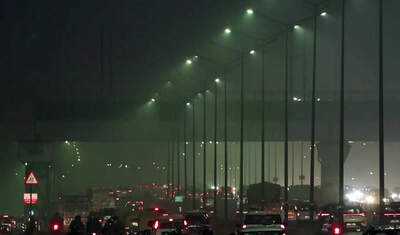
As part of the revised measures, the mandatory work-from-home requirement for offices has been eliminated, and hybrid learning modes in schools have also been discontinued. According to the Central Pollution Control Board (CPCB), a layer of smog enveloped the national capital on Wednesday morning, with the average Air Quality Index (AQI) recorded at 337 at 7 AM, which still falls under the 'very poor' category despite the implementation of GRAP-III.
Current Air Quality Levels
The AQI around India Gate was noted at 358, while the Ghazipur area recorded an AQI of 363. Near the All India Institute of Medical Sciences (AIIMS), the AQI was measured at 348. Toxic smog was visible in the South Extension area, where the AQI was also 348 at 7 AM. In Bawana, the AQI reached 377, categorizing it as 'very poor'. Meanwhile, ash clouds from Ethiopia's Heli Gubbi volcano are arriving in India, but environmentalist Vimalendu Jha indicated that these ash clouds would not have an immediate impact on Delhi's AQI.