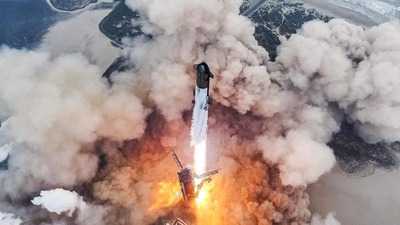
SpaceX aces key cryogenic test for next-gen Starship rocket
11 Feb 2026
SpaceX has successfully completed cryogenic proof testing of its upgraded Super Heavy booster, a major milestone toward the next Starship flight.
The achievement was announced by the company on social media, highlighting that this is the first time such operations have been completed with a Super Heavy V3 booster.
The multi-day campaign evaluated both the redesigned propellant systems and structural integrity of the new model.
The test campaign lasted 6 days
Testing process
The 237-foot-tall stainless-steel Super Heavy V3 booster was rolled out of its factory at Starbase, Texas, and transported to Massey's Test Site for testing.
The team first conducted a pressure test at ambient temperatures before filling the rocket with super-cold liquid nitrogen four times over six days.
This simulated the cryogenic methane and liquid oxygen that will be used in the propellant tanks on launch day.
SpaceX is gearing up for Starship's next flight
Future plans
The successful cryogenic proof test brings SpaceX one step closer to launching the first test flight of an upgraded version of its mega-rocket, Starship V3.
The previous version, Starship V2, was launched five times last year but failed on the first three attempts. However, the last two flights met SpaceX's objectives and led to the development of V3.
Booster 19 is back at the factory for modifications
Engine installation
The Super Heavy booster that failed during a pressure test in November has been replaced by Booster 19.
This new vehicle has successfully passed stress testing and is now back at the factory for further modifications.
Technicians will attach 33 Raptor engines at the bottom of the rocket and install grid fins, which are different from those on Starship V2.
What's new on Starship V3?
Design changes
The Raptor engines to be used on Starship V3 are more powerful and have been modified for improved reliability.
They are lighter with plumbing and sensors integrated into the engine's main structure, removing the need for independent heat shields between the engines at the rocket's base.
The new booster design also features three grid fins instead of four for controllability during descent.
The hot-staging ring has been integrated with the rocket
Upcoming trials
The hot-staging ring on the new Super Heavy booster is now integrated with the rocket to allow its return to Earth for reuse.
After getting its engines and grid fins, the Super Heavy booster will be taken to the launch pad at Starbase.
SpaceX's launch team will fill it with methane and liquid oxygen for a test-firing of its 33 engines.
The upgraded Starship will also be tested at Massey's site
Vehicle trials
Along with the Super Heavy booster, the first of SpaceX's upgraded Starship vehicles will also be tested.
This upper stage, which flies atop the Super Heavy booster, will be taken to Massey's Test Site for its own cryogenic proof test campaign.
It is also expected to undergo a static fire test of its six Raptor engines.