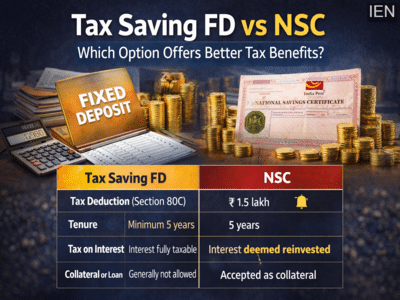
Tax Saving FD vs NSC: Which Investment Helps You Save More Tax?
For investors looking for safe investment options with tax benefits, Tax Saving Fixed Deposits (FD) and the National Savings Certificate (NSC) are among the most popular choices in India. Both options allow investors to claim tax deductions of up to ₹1.5 lakh under Section 80C of the Income Tax Act.
While both instruments help reduce taxable income and provide stable returns, there are important differences in interest rates, taxation rules, tenure, and flexibility. Understanding these differences can help investors choose the option that best suits their financial goals.
What Is a Tax Saving Fixed Deposit?A Tax Saving Fixed Deposit (FD) is a special bank deposit scheme designed for individuals who want to earn fixed returns while also claiming tax deductions.
When you invest in a tax-saving FD, the amount invested qualifies for tax deduction under Section 80C, up to the overall limit of ₹1.5 lakh per financial year.
Key Features of Tax Saving FD-
Lock-in period: Minimum of 5 years
-
Investment tenure: Usually ranges from 5 to 10 years depending on the bank
-
Interest rate: Approximately 5.5% to 7.75% annually, depending on the bank
-
Availability: Offered by most public and private sector banks
However, one major drawback is that the interest earned on tax-saving FDs is fully taxable. The interest income is added to your total income and taxed according to your applicable income tax slab.
Additionally, these FDs cannot be withdrawn before maturity, and loan facilities are generally not available against tax-saving FDs.
What Is National Savings Certificate (NSC)?The National Savings Certificate (NSC) is a government-backed savings scheme available through India Post offices. It is considered one of the safest long-term investment options because it is supported by the Government of India.
Like tax-saving FDs, investments in NSC also qualify for tax deduction under Section 80C, up to ₹1.5 lakh per year.
Key Features of NSC-
Tenure: Fixed maturity period of 5 years
-
Interest rate: Currently around 7.7% per year
-
Minimum investment: ₹1,000
-
Additional investment: Allowed in multiples of ₹100
One unique feature of NSC is the way interest is treated for taxation. The interest earned each year is considered reinvested in the scheme, and this reinvested interest is also eligible for Section 80C tax deduction (except in the final year).
Because of this reinvestment rule, NSC can sometimes provide slightly higher tax-saving benefits compared to tax-saving FDs.
Tax Saving FD vs NSC: Key Differences| Tenure | Minimum 5 years, up to 10 years | Fixed 5 years |
| Risk Level | Low risk, bank-backed | Low risk, government-backed |
| Tax Deduction | Up to ₹1.5 lakh under Section 80C | Up to ₹1.5 lakh under Section 80C |
| Minimum Investment | ₹1,000 to ₹10,000 (depends on bank) | ₹1,000 |
| Availability | Banks | Post offices |
| Loan Facility | Generally not allowed | Can be used as collateral for loans |
| Interest Rate | 5.5% – 7.75% depending on bank | Around 7.7% (reviewed quarterly) |
| Who Can Invest | Individuals, joint holders, minors | Individuals, joint holders, minors |
If we consider only Section 80C deductions, both tax-saving FDs and NSC offer the same benefit of up to ₹1.5 lakh per year.
However, the tax treatment of interest creates a difference in overall returns.
-
In Tax Saving FDs, the interest earned is fully taxable every year according to your income tax slab.
-
In NSC, the interest is considered reinvested, which allows investors to claim additional deductions under Section 80C for the first four years.
Because of this structure, NSC may provide slightly better tax efficiency for some investors.
Which Investment Is Better for You?The choice between Tax Saving FD and NSC depends on your investment preference and financial goals.
Tax Saving FD May Be Suitable If:-
You prefer investing through banks.
-
You want a simple and familiar investment product.
-
You already have a banking relationship with a preferred institution.
-
You want higher interest rates with government backing.
-
You are looking for better tax efficiency on interest income.
-
You may need to use the investment as collateral for a loan.
Before choosing between Tax Saving FD and NSC, investors should evaluate several factors, including:
-
Interest rates offered by banks or the government scheme
-
Lock-in period and liquidity needs
-
Your income tax slab
-
Long-term financial goals
Tax saving should not be the only reason for investment. The right choice is the one that aligns with your income level, risk tolerance, and financial planning strategy.
ConclusionBoth Tax Saving Fixed Deposits and National Savings Certificates are reliable investment options for individuals seeking stable returns and tax benefits. While both offer deductions under Section 80C, NSC may provide slightly better tax efficiency due to the reinvestment of interest.
Ultimately, the better option depends on your investment preference, tax planning strategy, and long-term financial objectives.