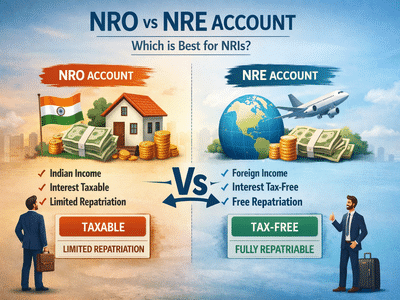
For Non-Resident Indians (NRIs), managing money in India comes with a different set of banking rules. If you live or work abroad, choosing the right bank account is crucial—not just for convenience but also for tax efficiency and smooth fund transfers.
Under the Foreign Exchange Management Act (FEMA), NRIs can open three types of accounts in India: NRO, NRE, and FCNR. Among these, NRO (Non-Resident Ordinary) and NRE (Non-Resident External) accounts are the most commonly used.
Here’s a complete, easy-to-understand guide to help you choose the right one.
Who Is Considered an NRI?As per FEMA rules, an NRI is:
- An Indian citizen living outside India, or
- A Person of Indian Origin (PIO) residing abroad
Such individuals must maintain specific types of accounts instead of regular savings accounts in India.
What Is an NRO Account?An NRO account is designed to manage income earned within India.
Key Features:- Used for Indian income like:
- Rent
- Pension
- Dividends
- Property sale proceeds
- Can be opened as:
- Savings, Current, Fixed Deposit, or Recurring account
- Can be held jointly with:
- Another NRI or a resident Indian
- Funds can be deposited from India or abroad
- Repatriation (sending money abroad) is restricted
- Maximum transfer limit: $1 million per financial year (subject to taxes)
An NRE account is meant for income earned outside India.
Key Features:- Only NRIs can open this account
- Funds must come from foreign income
- Fully repatriable (no limit on sending money abroad)
- Can be opened as savings, current, or fixed deposit account
- Can be used for investments in India
- Can pay EMIs for home loans
- Eligible for loans in India and abroad
One of the most important differences between NRO and NRE accounts is taxation.
NRO Account:- Interest earned is taxable in India
- Banks deduct TDS (Tax Deducted at Source)
- Interest earned is completely tax-free in India
- Tax benefits apply only while you maintain NRI status
Once you return to India and become a resident, NRE account interest becomes taxable.
Key Difference at a Glance| Purpose | Indian income | Foreign income |
| Tax on Interest | Taxable | Tax-free |
| Repatriation | Limited ($1M/year) | Unlimited |
| Joint Account | With NRI/Resident | Only with NRI |
| Deposit Source | India + Abroad | Abroad only |
You can transfer funds from an NRE account to an NRO account. However:
- Once funds move to NRO, free repatriation benefits are lost
- Future transfers abroad may become restricted and taxable
So, plan such transfers carefully.
Which Account Should You Choose? Choose NRO Account If:- You earn income in India
- You need to manage rent, pension, or local earnings
- You earn abroad and want to park money in India
- You want tax-free interest and easy repatriation
Both NRO and NRE accounts serve different purposes, and choosing the right one depends on your income source and financial goals. While NRO accounts help manage Indian income, NRE accounts offer tax-free benefits and hassle-free global transfers.
For most NRIs, using a combination of both accounts is often the smartest strategy to balance tax efficiency and flexibility.