The Cadillac Lyriq was introduced as a statement about where electric luxury vehicles are heading. It promised range, comfort, and a quiet ride, all wrapped in a design meant to signal a clean break from combustion-era thinking. Yet beneath that calm exterior sits a set of choices that drivers make every day, often without much thought. Among them is the selection of driving modes, a feature that raises a simple question with a complicated answer: do these modes actually change how far the vehicle can go on a charge?
The official numbers suggest stability. The Lyriq’s battery, with about 102 kilowatt-hours of usable capacity, does not change from one mode to another. The Environmental Protection Agency range estimates, roughly 300 miles or more depending on configuration, also remain fixed. But drivers who spend time behind the wheel tend to notice something else. The range shown on the display, and the rate at which it drops, can feel very different depending on how the car is set up.
That difference does not come from hidden capacity or software tricks that unlock extra energy. It comes from how the vehicle chooses to use the energy it already has. Driving modes are, in effect, instructions to the car about how to behave. Those instructions influence acceleration, regenerative braking, steering weight, and even how quickly the vehicle responds to the driver’s right foot.
How software changes energy use without changing the battery
At first glance, it may seem counterintuitive that a simple setting could affect range. After all, the battery stores a fixed amount of energy. But range is not just about how much energy is available. It is about how quickly that energy is consumed.
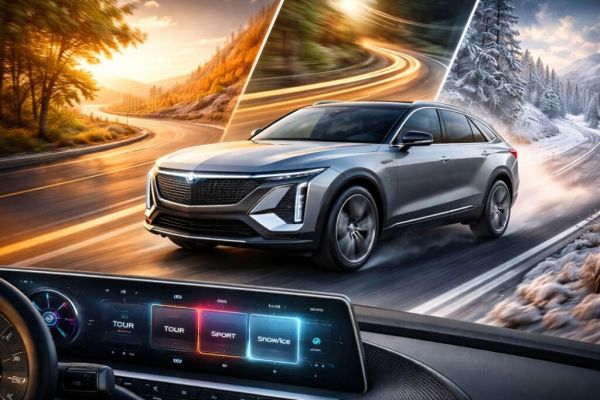
In its default Tour mode, the Lyriq leans toward restraint. Acceleration is smooth rather than abrupt, and the vehicle encourages gradual changes in speed. Regenerative braking, which recovers energy when slowing down, is tuned to capture as much as possible without making the ride feel unnatural. The result is a driving pattern that uses energy more slowly.
Switch to Sport mode, and the same battery begins to behave differently. The throttle becomes more responsive, allowing quicker bursts of acceleration. Steering tightens, and the vehicle feels more eager to respond. None of this creates new energy, but it changes how often and how intensely the motor draws from the battery.
The effect is cumulative. A single quick acceleration may not seem significant, but repeated over a drive, it adds up. Energy that might have been used gradually in Tour mode is consumed more rapidly in Sport. In real-world terms, this can reduce range by a noticeable margin, sometimes by tens of miles on a full charge.
Snow or Ice mode introduces a different kind of adjustment. Instead of sharpening responses, it softens them. Power delivery becomes more controlled to prevent wheel slip on low-traction surfaces. This can lead to steadier energy use, though the primary aim is safety rather than efficiency. In cold conditions, other factors such as battery temperature and cabin heating often play a larger role in overall range.
There is also a customizable setting, often referred to as My Mode, which allows drivers to mix elements from different profiles. A driver might choose the gentle acceleration of Tour with the steering feel of Sport. In these cases, the effect on range depends entirely on how those elements are combined. The vehicle does not impose a fixed outcome; it responds to the driver’s preferences.
The gap between official range and daily driving
The official range figures for the Lyriq are based on standardized testing cycles. These tests aim to provide a consistent benchmark, but they cannot account for every real-world variable. Driving modes are one of those variables.
In practice, many drivers find that Tour mode brings them closest to the published numbers. Under steady conditions, moderate speeds, mild temperatures, and careful driving, it is possible to match or even exceed the official estimate. This is not because the car is outperforming its rating, but because the conditions align closely with those used in testing.
Sport mode tends to move the experience in the opposite direction. The emphasis on quicker response encourages a style of driving that consumes more energy. Even if a driver does not intend to drive aggressively, the vehicle’s behavior can nudge them toward higher consumption. The difference is not constant, but it is consistent enough to be noticeable.
Highway driving adds another layer. At higher speeds, energy use rises due to aerodynamic drag. In this context, the gap between modes can widen. Quick accelerations to pass other vehicles, combined with sustained high speeds, can lead to faster depletion of the battery. The mode itself does not create this effect, but it influences how often those actions occur.
Temperature also plays a role. Cold weather can reduce battery efficiency and increase the need for heating, while hot weather may require more cooling. These conditions can overshadow the effect of driving modes, but they do not eliminate it. Instead, they interact with it, sometimes making differences more pronounced.
What emerges from all this is a picture of range as a variable outcome rather than a fixed number. The battery sets the upper limit, but the path to that limit depends on how the vehicle is driven and configured