शरीरं यद्यपि त्यक्तं, तदेकत्वं न मुञ्चति।
स्नेहं रूपं च शक्तेश्च, भूता भूतेषु जीवति॥
Even if the body is gone, the essence of the Goddess lives on in every form of creation.
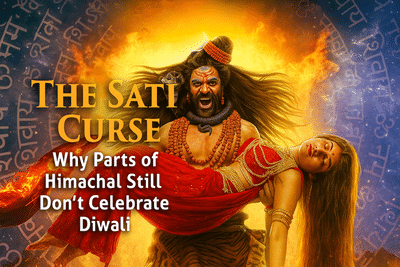
While the rest of India glows with lamps, fireworks, and joy during Diwali, certain villages in Himachal Pradesh fall silent. No diyas are lit, no sweets exchanged, and no prayers offered to Goddess Lakshmi. In places like Kullu, Nirmand, Ani, and Naraingarh, Diwali is not a festival of light but a reminder of grief — a grief rooted in an ancient curse believed to be pronounced by Goddess Sati herself.
This tradition, followed for centuries, is one of India’s most fascinating intersections of mythology, faith, and cultural memory. To understand it, we must return to the beginning — to the fire that started it all.
1. The Story of Sati’s Sacrifice  The goddess we worship bled, suffered, and rose in power. Why then do we shame women who carry the same power within? According to Hindu scriptures, Goddess Sati was the daughter of King Daksha and the first consort of Lord Shiva. When Daksha organized a grand yajna, he invited every deity except Shiva, disapproving of his ascetic lifestyle. Sati, out of devotion and longing, attended the yajna against Shiva’s wishes. There, Daksha publicly insulted Shiva, humiliating her before the entire assembly.
Unable to bear the disrespect toward her husband, Sati immolated herself in the sacred fire. When Shiva learned of her death, his grief turned to rage. Carrying Sati’s lifeless body across the universe, Shiva unleashed the Tandava — the dance of destruction.
It was only after Lord Vishnu intervened, cutting Sati’s body into 51 pieces with his Sudarshana Chakra, that Shiva’s fury subsided. Each fragment of Sati’s body is believed to have fallen in different parts of the Indian subcontinent, becoming sacred
Shakti Peethas.
One of those fragments, as local Himachal legends say, fell in the Kullu region — and with it came the Goddess’s eternal sorrow.
2. The Birth of the Curse  True wealth is what remains after letting go. Local oral traditions claim that when Sati’s body part fell in Himachal, the land itself trembled. The gods who witnessed her pain decreed that no festival of joy would be celebrated there until the mountains themselves forgave the insult done to the Goddess.
It is said that before her body turned to ash, Sati cursed the people and the land around the site of her fall — that no light of celebration should be lit on the day that marked her death. Since Sati had immolated herself on the
amavasya (new moon) night, the same night on which Diwali is celebrated, these regions refrain from lighting lamps.
For them, it is not a night of victory but of remembrance.
3. The Villages That Still Follow the Curse  Shiva and Shakti: What Modern Relationships Can Learn From Divine Balance Even today, several parts of Himachal Pradesh continue this age-old practice. The most well-known among them are:
- Nirmand (Kullu District): Often called the “Kashi of the Himalayas,” Nirmand is deeply associated with the legend of Sati. The local temple of Parashurama and Mahamaya marks the sanctity of the place, and Diwali is observed as a day of mourning rather than celebration.
- Ani and Naraingarh Villages: Located close to Nirmand, these areas also remain dark during Diwali. Locals believe that lighting lamps on this night might invite misfortune or divine displeasure.
- Some Parts of Sirmaur and Kinnaur: Oral traditions differ slightly, but the core belief remains the same — that Diwali coincides with Sati’s sacrifice and must therefore not be celebrated.
Margashirsha Krishna Paksha Amavasya. This celebration marks the return of the gods from their mythical journey after the harvest season and symbolizes balance — joy after grief, light after darkness.
4. The Role of “Buddhi Diwali”Buddhi Diwali, or the Old Diwali, is one of the most unique regional festivals in India. It reflects how myth and local culture coexist to create distinct traditions.
During Buddhi Diwali, the same villages that stayed silent on the original Diwali burst into color, folk music, and ritual. In Kullu’s Sainj and Ani valleys, villagers decorate their homes with pine torches instead of clay lamps, symbolizing the flames of purification rather than celebration.
Cattle are adorned, ancient dances like
Natti are performed, and local deities are carried out in processions. Yet, even in festivity, reverence for Sati remains — as if the people are waiting for her forgiveness before they can truly rejoice.
5. Myth and Belief Interwoven with GeographyHimachal Pradesh is home to several
Shakti Peethas, including Naina Devi, Chintpurni, Jwala Ji, and Chamunda Devi — all connected to different parts of Sati’s body. The very landscape of the state is infused with her memory, turning mountains into myths and rivers into relics of devotion.
 In this context, the Sati curse is not seen as superstition but as sacred continuity. For centuries, these traditions have preserved a sense of divine presence across generations. Even when modern life reached the hills, the people held onto their vow — that the night of Sati’s sacrifice will remain one of silence and reflection.
 6. The Deeper Meaning Behind the DarknessBeyond mythology, the practice reflects a profound cultural truth. Festivals in India are not merely celebrations but ways of remembering collective emotion — joy, sorrow, triumph, or loss. In these Himachali villages, the refusal to celebrate Diwali is not rejection but remembrance.
It represents respect for the Goddess who gave her life for dharma, a reminder that even divine beings endure pain for cosmic balance. The darkness becomes symbolic of introspection — of light withheld in reverence rather than ignorance.
7. What the Tradition Teaches Us
 Embrace the warmth of Diwali traditions, reimagined for a flame-free, pet-safe celebration. This centuries-old practice carries lessons for a world that often rushes to celebrate without understanding the roots of faith.
 Perhaps that is the true light they guard, one that burns not in the open flame of a lamp, but in the unseen devotion of remembrance.