Many darts fans are only just realising why the centre of the board is known as the bullseye. It's nearly time for Christmas and that means the World Darts Championship will be gracing our screens for the foreseeable future. Luke Littler will be hoping to defend his title at Alexandra Palace and become the first player to win twice in a row since Gary Anderson in 2015 and 2016.
Even the uninitiated who don't know their doubles from their trebles will be familiar with the term 'bullseye'. It has transcended the sport and is commonly used to mean accuracy in any given context. In fact, the term has been in use since the early 1800s when it had an entirely different meaning.
It was originally used to describe a type of boiled sweet, while it can also refer to a circular piece of glass with a lump in the middle. Going back even further, it was used in the 1680s when referring to small holes that looked like little eyes.
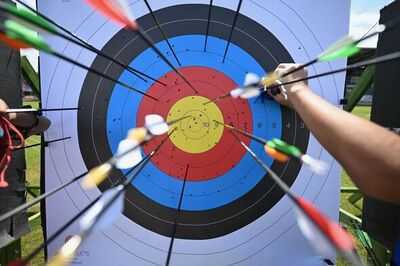
The term didn't take on its modern-day meaning until around 1833, when it became associated with the centre of a target in archery.
Targets were named as such because they commonly took the form of a small circle with an even smaller one in the middle, resembling an eye. By the late 1850s, 'bullseye' had been broadened to also refer to a 'shot that hit the mark'.
A common but unproven theory suggests the term was influenced by a method used by archers to sharpen their skills when bows and arrows were still in use.
It was thought that bull skulls would be used for target practice under the assumption that if they could be shattered by a direct hit, the same would also apply to a human skull.
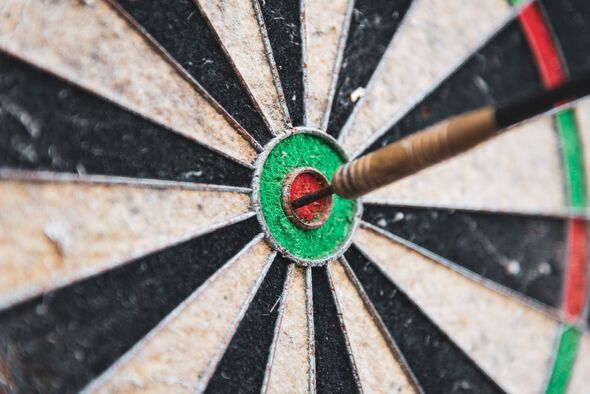
These days, the term is mostly used in a sporting context to refer to the middle section of a dartboard, which is worth 50 points if hit.
It has become synonymous with the sport and was the title of a popular darts-themed game show which aired in the UK during the 1980s and 1990s. The programme was recently revived by ITV and is currently hosted by Freddie Flintoff.
Fans can expect to see plenty of bullseyes hit during the World Darts Championship, with the crowd-pleasing 'big fish' a popular checkout.
It is the highest possible finish and is achieved by hitting two treble-20s and the bullseye with three darts. The origin of the name 'big fish' is unclear, but it may refer to its rarity and the way people tend to brag about their fishing stories.
Players who successfully take out the 'big fish' often celebrate with gestures relating to the unusual name, like pretending to wind up a fishing reel.