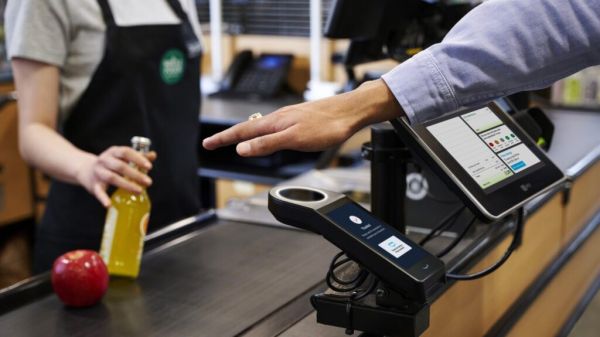
Amazon is preparing to shut down one of its most experimental retail technologies, signaling a retreat from biometric payments inside its grocery business. The company will remove Amazon One palm-scanning devices from every Whole Foods Market store by June 3, ending a checkout option that once symbolized Amazon’s ambition to redefine how people pay in physical stores.
The palm-based system, which allowed customers to complete purchases by hovering their hand over a scanner, was marketed as a fast, contactless alternative to cards and smartphones. However, several years after its introduction, the technology failed to gain widespread traction among shoppers, prompting Amazon to discontinue the service altogether.
A Futuristic Idea That Struggled to Catch On
Amazon One was introduced as a biometric authentication system designed to make payments and entry points quicker and more seamless. Instead of using fingerprints or facial recognition, the system relied on palm recognition, scanning both the surface of a person’s hand and the vein patterns beneath the skin.
Customers interested in using the service had to enroll ahead of time, providing personal details and linking a payment method. Once registered, users could pay or access participating locations simply by holding their palm above a sensor for a few seconds. In theory, the process eliminated the need for wallets, phones, or physical cards.
Despite its futuristic appeal, Amazon One remained a niche option. Many shoppers continued to rely on familiar payment methods, such as credit cards, mobile wallets, or cash. Over time, it became clear that the novelty of palm scanning was not enough to drive mass adoption in everyday grocery shopping.
Limited Use Leads to Discontinuation
Amazon has acknowledged that customer interest in Amazon One remained limited. According to information published on an Amazon support page and reported by GeekWire, the company decided to discontinue the service due to low usage. Amazon has also confirmed that all customer data associated with Amazon One will be securely deleted once the system is fully shut down.
Users enrolled in the program were notified of the decision earlier this week, according to grocery industry publication Grocery Dive. Amazon has not released figures on how many customers signed up for Amazon One or how frequently the service was used at Whole Foods stores.
The removal of the palm scanners marks a quiet end to a technology that once played a central role in Amazon’s vision of frictionless, automated retail.
From Seattle Test Sites to National Rollout
Amazon One first appeared in 2020 at a handful of Amazon Go convenience stores in Seattle. These locations were already known for their cashierless model, which used sensors and cameras to automatically track items as customers picked them up.
After initial testing, Amazon expanded palm scanning to hundreds of Whole Foods locations across the United States. The technology later spread beyond grocery stores, appearing at other Amazon-affiliated businesses, including select Panera Bread restaurants.
Amazon also pushed the system into high-traffic public venues. Palm readers were installed at sports stadiums and arenas used by teams in major professional leagues, including football, basketball, baseball, and hockey. In these environments, Amazon One was positioned as a way to speed up entry lines and reduce congestion at concession stands.
Entertainment Industry Pushback
Amazon’s efforts to expand Amazon One into live entertainment faced significant resistance. In 2021, concert promoter AEG announced plans to introduce the technology at Red Rocks Amphitheatre in Colorado, allowing ticketless entry for attendees who enrolled in the palm-scanning system.
The proposal quickly sparked controversy. Hundreds of musicians and artists publicly opposed the move, expressing concern about privacy, surveillance, and the normalization of biometric data collection at cultural venues. High-profile opposition amplified the backlash, drawing national attention to the issue.
Following sustained criticism and organized protests, the plan to deploy Amazon One at Red Rocks was ultimately abandoned. The episode became one of the most visible examples of public resistance to biometric technologies in entertainment settings.
Ongoing Privacy and Surveillance Concerns
Privacy advocates have long raised alarms about biometric systems, arguing they carry risks that extend beyond convenience. Groups critical of Amazon One warned that tools like palm scanning and facial recognition could enable intrusive surveillance and expose individuals to data misuse.
Advocacy organization Fight for the Future played a central role in opposing Amazon One’s use in live events. The group argued that biometric technologies could turn public venues into spaces vulnerable to law enforcement overreach, misidentification, and identity theft.
Although Amazon has repeatedly emphasized that its biometric data was encrypted and stored securely, critics maintained that any system collecting unique biological identifiers carries inherent risks, especially if data were ever compromised or repurposed.
Part of Amazon’s Broader Retail Pullback
The decision to remove Amazon One from Whole Foods aligns with a broader scaling back of Amazon’s physical retail experiments. The Seattle-based company has recently reduced its brick-and-mortar footprint, closing most Amazon Go convenience stores and Amazon Fresh grocery locations earlier this year, with a few exceptions in California.
These closures marked a shift away from Amazon’s earlier strategy of aggressively testing new retail formats powered by automation and advanced technology. While Whole Foods remains a key part of Amazon’s grocery business, the company appears to be prioritizing simpler, more familiar shopping experiences.