Could prime numbers help us unlock secrets of black holes?
10 Mar 2026
In a groundbreaking study, scientists have proposed that prime numbers could hold the key to understanding the chaotic regions inside black holes.
The research highlights a surprising connection between number theory and the extreme environments of the universe.
Prime numbers, which are integers greater than one that can only be divided by one and themselves, may play an important role in black hole physics patterns.
Singularity and prime number patterns
Black hole's core
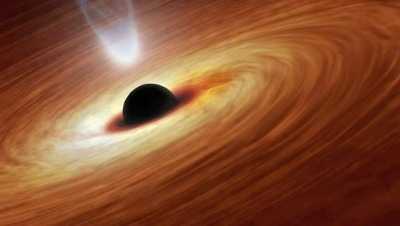
At the heart of every black hole lies a singularity, an area where gravity is so strong that the laws of physics as we know them break down.
Here, space and time behave in strange and unexpected ways.
Scientists believe this region could harbor undiscovered mathematical patterns, with recent studies suggesting that these chaotic behaviors could be described by prime number patterns.
What are prime numbers?
Mathematical foundations
Prime numbers are the basic building blocks of mathematics, including values such as 2, 3, 5, and 7. They can only be divided by one and themselves.
Physicists now think that the chaotic behavior near black hole centers may follow similar patterns.
This idea connects number theory with gravity physics, suggesting a deeper mathematical structure underlying these extreme cosmic phenomena.
Prime numbers and black holes
Mathematical tool
Researchers study the subtle mathematical structures of prime numbers using complex functions and equations, one of which is the Riemann zeta function.
This function helps explain how primes appear along the number line.
Physicists have found similar patterns in equations describing chaotic gravitational systems, including those near black hole singularities.
This suggests a potential link between prime number distribution and black hole dynamics.
Primons and their significance
Hypothetical particle
Decades ago, physicists proposed a hypothetical particle called a "primon," where each particle's energy level is related to prime numbers.
The mathematical description of this idea involves the Riemann zeta function, which plays a central role in understanding prime number distribution.
Initially seen as purely mathematical and highly speculative, new research suggests similar mathematics may appear in black holes, reviving the theory of primons.