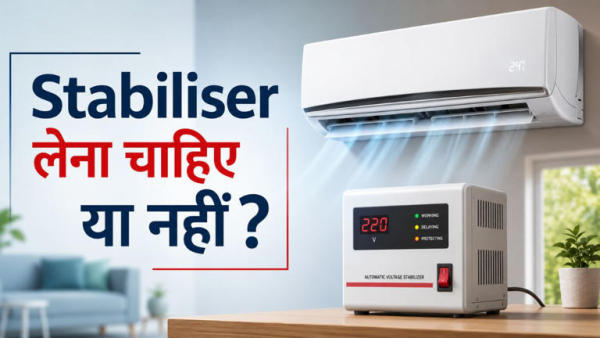
As soon as the scorching summer season starts, the demand for air conditioners (AC) suddenly starts skyrocketing in the markets. If you are also planning to buy a new AC for your home this season, then the showroom salesman definitely advises you to buy a separate voltage stabilizer along with the AC. In such a situation, it is natural for the question to arise in the mind that when today’s companies are already providing the facility of ‘built-in voltage protection’ (In-built Stabilizer) in most of the advanced Inverter ACs, then why spend money separately and get a stabilizer? Let us clear this confusion in very easy and practical language. Why have today’s inverter ACs become so smart? Technically speaking, today’s advanced inverter ACs have been much upgraded compared to the old split or window ACs of earlier times. These have smart technology that automatically handles voltage fluctuations. ACs of most of the new and good brands coming in the market can easily withstand the voltage range of 160V to 290V without any external support. This simply means that if you live in a city or a posh area where the electricity supply is completely stable, then there is no need to hang a heavy stabilizer separately. AC with stabilizer vs without stabilizer, you can easily understand which option will be better according to the electricity of your house and area, from the table given below: So when does an external stabilizer become a ‘lifesaver’? Even though companies claim to have an in-built stabilizer, this protection only works to a certain extent. It completely depends on the ground reality of electricity in your area. Stabilizer is the insurance of the compressor. If there are frequent power outages in your area, the transformer is overloaded or the voltage often falls below 160V, then installing an external stabilizer would be the wisest decision. When a large or dangerous power surge occurs, the stabilizer itself gets damaged but it completely protects the most expensive part of your AC – the compressor and the PCB (circuit board) inside it from getting burnt. Without a stabilizer, the repair cost can easily run into thousands of rupees if a PCB burns. What effect does it have on your pocket and electricity bill? One small thing that most people often overlook is the stabilizer’s own power consumption. When you install an external stabilizer, it consumes about 10 to 20 watts of power due to its continuous operation. It may seem very small, but due to this, an additional expense of about Rs 150 to Rs 300 is added to your annual electricity bill. On the contrary, if you just run the inverter AC directly, this unnecessary expense is completely saved. Final Word: What should you do? Simply put, buying a stabilizer depends more on the power system in your area than on your needs. If the voltage in your house remains absolutely correct and stable, then feel free to run inverter AC without stabilizer and save money. But if electricity is not reliable in your area and the voltage often fluctuates, then getting a good stabilizer will prove to be a great investment for the long life of the AC.